
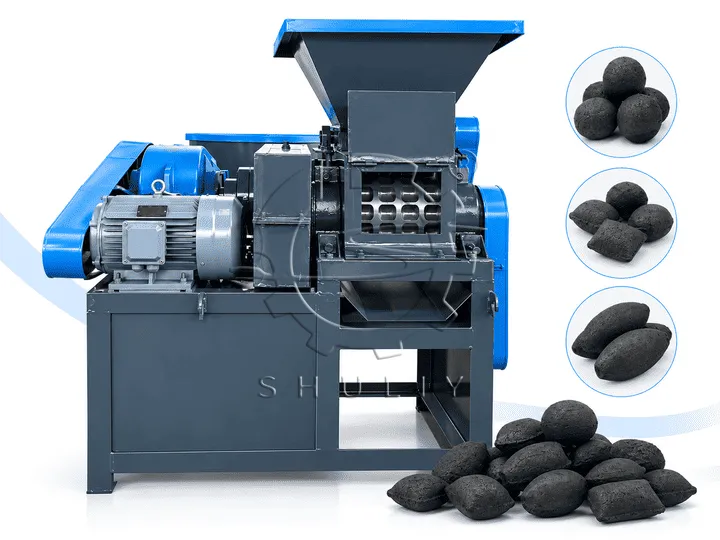
Charcoal Ball Press Machine for Making BBQ Charcoal Briquettes
Our charcoal ball press machine is designed to compress charcoal powder, coal powder, and other suitable powdered materials…
Our charcoal ball press machine is designed to compress charcoal powder, coal powder, and other suitable powdered materials into compact briquettes of different shapes. It is an ideal choice for manufacturers who want to process loose powder into easy-to-handle fuel products for BBQ charcoal production and other applications.
We provide charcoal briquette pressing solutions based on your raw materials, required output, and finished product specifications. Whether you need a standalone charcoal ball press or a complete production line, we can help you select the right equipment.
1. What Is a Charcoal Ball Press Machine?
A charcoal press machine, also known as a charcoal powder briquette machine, uses two rotating rollers with shaped molds to compress powdered materials into briquettes.
During operation, the prepared material enters the space between the rollers. As the rollers rotate toward each other, the material is compressed into the mold cavities and discharged as formed briquettes.
This machine is commonly used to produce:
- BBQ charcoal briquettes
- Charcoal powder balls
- Pillow-shaped charcoal briquettes
- Coal briquettes
- Other suitable powder-based briquettes
The final product shape and size depend on the roller molds selected for your production requirements.
2. What Materials Can the Charcoal Ball Press Process?
Our charcoal briquette press machine can process various powdered materials, provided their physical properties are suitable for the selected machine and forming process.
Common materials include:
- Charcoal powder: Converts loose charcoal powder into shaped fuel products.
- Coal powder: Compresses suitable coal fines into briquettes.
- Biomass charcoal powder: Can be considered for briquette production after evaluating its composition and binding requirements.
- Other mineral powders: Certain materials, such as iron ore powder and other industrial powders, may require a suitable machine configuration and forming pressure.
For charcoal briquette production, the feed material should be prepared before pressing. We recommend controlling the particle size, moisture content, and binder ratio to achieve the desired briquette strength.
For example, the reference equipment configuration recommends a feed particle size of no more than 3 mm. Actual requirements should be confirmed according to your material and machine model.
3. Different Briquette Shapes Available
One advantage of a charcoal ball press machine is its ability to produce different briquette shapes by changing the roller molds.
Available shapes may include:
- Round or ball-shaped briquettes
- Pillow-shaped briquettes
- Oval or rugby-shaped briquettes
- Square-shaped briquettes
- Heart-shaped briquettes
- Custom shapes designed according to customer requirements
For BBQ charcoal manufacturers, pillow-shaped and oval briquettes are common options. Other shapes can be considered for specific product designs or market requirements.
We can discuss your preferred briquette dimensions and shape before recommending the appropriate mold configuration.
4. What Are the Applications of Charcoal Briquettes?
The finished products made by a charcoal ball press machine can be used in various fuel applications. By compressing loose charcoal powder into uniform shapes, the machine makes the briquettes easier to collect, store, package, and transport.
- BBQ Fuel: Charcoal powder can be compressed into round or pillow-shaped briquettes for use in BBQ grills, providing a heat source for cooking.
- Heating Fuel: Charcoal briquettes that meet local fuel-use requirements can be used in compatible heating appliances.
- Commercial Fuel: Depending on their calorific value, combustion characteristics, and mechanical strength, charcoal briquettes can be used in certain commercial fuel applications.
- Charcoal Powder Recycling: Loose charcoal powder generated during production can be compressed into briquettes, reducing powder loss and improving raw material utilization.
Different applications have different requirements for briquette size, density, resistance to breakage, burning time, and ash content. Therefore, when selecting a charcoal ball press machine and its molds, we recommend considering the intended application of the finished briquettes to determine the most suitable forming solution.
5. How Does a Charcoal Ball Press Machine Work?
The charcoal ball press machine uses mechanical pressure to shape loose powder into compact briquettes. Its working process consists of four main steps.
Step 1: Feed the prepared material
The mixed charcoal powder enters the feeding hopper and moves toward the forming rollers.
Step 2: Rotate the rollers
The motor and transmission system drive the rollers in opposite directions, bringing the material into the forming area.
Step 3: Compress the powder
The powder is pressed into the cavities on the roller surfaces. Each pair of matching mold cavities forms a briquette as the rollers rotate.
Step 4: Discharge the finished briquettes
The formed products leave the rollers and are collected for screening, drying, or subsequent processing, depending on the production setup.
This roller-pressing method allows continuous feeding and forming, making it suitable for commercial briquette production.
6. BBQ Charcoal Making Machine Models and Capacity
We offer charcoal ball press machines in different models to meet various production requirements. For customers with small- to medium-scale production needs, the following two models are available:
| Mfano | Motoreffekt | Uwezo |
| SL-290 | 5.5 kW | 1–2 tons/h |
| SL-360 | 7.5 kW | 2–3 tons/h |
If your project requires a higher production capacity, we also offer larger models with a maximum capacity of 20–30 tons per hour. We will recommend the appropriate charcoal briquette making machine model according to your raw materials, target output, and finished briquette specifications, helping you select equipment that matches your production needs.
7. How to Set Up a Charcoal Briquette Production Line
If you already have charcoal powder, you may only need mixing, pressing, drying, and packaging equipment. If you start with charcoal blocks or need to produce charcoal from raw biomass, additional upstream machinery may be required.
A typical charcoal briquette production process is:
Carbonization → Crushing → Powder mixing → Ball pressing → Drying → Packaging
The main equipment can include:
- Carbonization Furnace: Carbonizes wood, sawdust, or other suitable biomass materials to produce charcoal.
- Charcoal Crusher: Crushes the carbonized charcoal blocks into powder suitable for briquette pressing.
- Charcoal Powder Mixer: Thoroughly mixes the charcoal powder with an appropriate amount of binder and water to ensure a uniform mixture suitable for forming.
- Charcoal Ball Press Machine: Compresses the mixed charcoal powder into round, pillow-shaped, or other customized briquette shapes.
- Drying Equipment: Dries the formed charcoal briquettes to reduce moisture content and improve storage stability.
- Packaging Machine: Packages the dried charcoal briquettes for convenient storage, transportation, and sale.
The exact configuration depends on your starting material and production target. We can recommend a suitable equipment combination after understanding your existing processing conditions.
8. How to Choose the Right Charcoal Powder Briquette Machine
Before selecting a charcoal powder briquette machine, consider the following factors.
- Raw material type: Charcoal powder, coal powder, and mineral powders have different forming characteristics. Tell us what material you plan to process so we can evaluate the suitable configuration.
- Capacidad de producción requerida: Your target hourly output helps determine the roller size, motor power, and number of machines needed.
- Briquette shape and dimensions: Different products require corresponding roller molds. Confirm the shape and size you want before selecting the machine.
- Binder and moisture requirements: Some materials need a binder to improve briquette strength. The appropriate formulation should be established through material testing.
- Downstream processing: If the briquettes need to meet specific moisture or packaging requirements, consider the necessary drying and packaging equipment as part of the overall solution.
9. What Is the Difference Between a Charcoal Ball Press Machine and a Charcoal Briquette Extruder?
Charcoal Press Machine
A charcoal ball press machine uses rotating rollers with mold cavities to compress powdered materials into briquettes. Common finished product shapes include round, oval, and pillow-shaped briquettes.
Charcoal Briquette Extruder
A charcoal briquette extruder typically uses an extrusion process to continuously form the material into rods. The finished products are commonly cylindrical, hollow, or hexagonal briquettes.
In simple terms, if you want to process charcoal powder into ball-shaped fuel, a charcoal ball press machine may be a suitable choice. If you want to produce rod-shaped charcoal briquettes, a corresponding charcoal briquette extruder is more appropriate.
The most important factors when selecting a machine are your raw materials and finished product requirements. Whether you plan to process charcoal powder, coal powder, or other powdered materials, your target production capacity and desired briquette shape will all influence the choice of equipment.
10. Get a Charcoal Ball Press Machine Solution for Your Business
Choosing a charcoal ball press machine involves more than comparing motor power or machine dimensions. The raw material, forming mold, required capacity, and finished product quality all affect the final equipment configuration.
As a machinery supplier, we can help you evaluate your processing requirements and select suitable pressing equipment and auxiliary machinery.
Contact us with the following information to receive a suitable recommendation:
- What raw material will you process?
- What is your target capacity in tons per hour?
- What shape and size of briquettes do you want to produce?
- Do you already have charcoal powder, or do you need a complete production line?
Send us your requirements, and we will help you find a suitable charcoal ball press machine for your production project.